


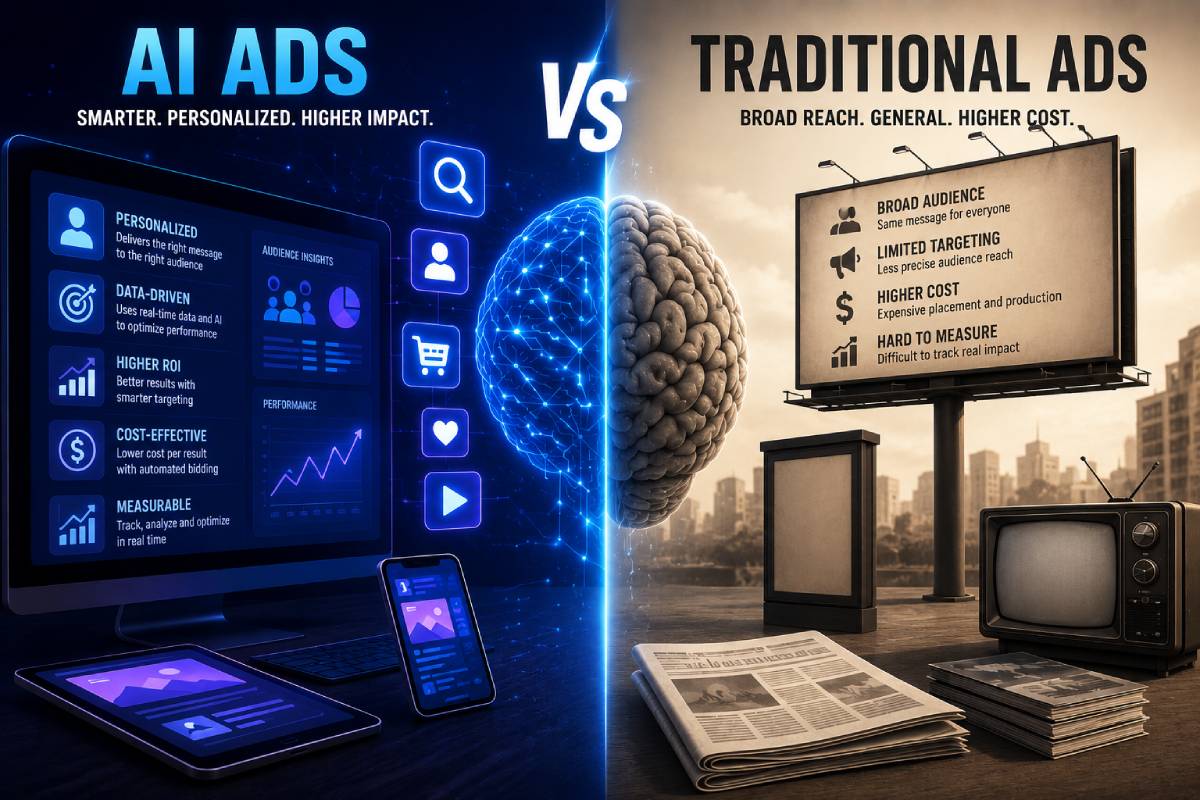
AI Ads vs Traditional Ads: Choosing an AI Ads Production Agency in Dubai in 2026
1 July, 2026Advertising production followed a familiar route for years. A business approached an agency, discussed the brief, developed a concept and then moved through planning, filming, editing and final delivery of the Ad. For major campaigns, that model remains highly relevant.
Traditional Route
Creative Brief -> Ideating the Campaign -> Execution -> Internal Review -> Client Feedback -> Final Delivery
But businesses now have another option.
AI-powered advertising production in Dubai is changing how quickly an idea can move from a conversation to a finished commercial. Instead of replacing traditional advertising altogether, it introduces a different production model – one built around speed, experimentation and creative flexibility. Digiant Media is emerging as one of Dubai’s leading company in AI‑powered advertising, setting the benchmark for next‑generation creative production.
For businesses considering an AI Ads Production Agency in Dubai, the important question is not whether traditional production is outdated. It is which approach makes more sense for the campaign you are trying to create.
Here are four areas where the differences become clear.
1. Speed: From Production Schedules to Rapid Execution
Traditional advertising involves many moving parts.
Concept approval may be followed by casting, locations, equipment, production crews, shooting schedules, editing and revisions. There is a reason for this process: a professionally produced commercial in UAE requires coordination.
AI production changes that workflow considerably.
Once the creative direction is established, concepts can potentially be visualised and developed much faster. There is no need to wait for the right weather, rebuild a physical set or organise another shooting day simply to explore a different visual direction.
This becomes particularly useful in Dubai, where brands constantly advertise around Ramadan, Eid, property launches, exhibitions, seasonal promotions and retail campaigns.
When the market moves quickly, production speed matters.
The advantage: AI advertising in Dubai, particularly when businesses need to create, test or adapt content quickly.
2. Production Economics: More Room to Experiment
Traditional commercial production can involve substantial resources.
Locations, models, photographers, videographers, equipment, transportation, set design and post-production all contribute to the final budget.
And changing the concept after filming can sometimes mean doing parts of it again.
AI video production works differently.
It can reduce dependence on many physical production requirements and makes it easier to explore alternative scenes, visual directions and campaign variations.
This changes the economics of experimentation.
Instead of putting the majority of a campaign budget behind one creative idea, brands can potentially explore several approaches and discover what resonates with their audience.
That is particularly valuable for social media AI advertising and performance campaigns, where audiences, formats and messages continually change.
The advantage: AI production for frequent and varied content.
Traditional production, however, can remain the right investment when the physical scale and craftsmanship of the shoot are themselves central to the campaign.
3. Creative Quality: Technology Isn’t the Creative Director
There is a misconception that AI advertising means typing a few sentences into software and receiving a finished commercial.
Technically, you can.
Whether anyone will want to watch it is another question.
The increasing availability of AI tools means the technology itself is becoming less of a differentiator.
The idea becomes the differentiator.
Strong AI advertising still requires concept development, creative direction, storytelling, composition, editing, pacing, sound and an understanding of the brand.
AI can create extraordinary environments and visual sequences that would once have required substantial production resources. But without direction, those same tools can produce content that feels generic.
Traditional production faces the same fundamental reality.
An expensive camera does not guarantee a memorable advertisement.
Neither does an expensive AI subscription.
The advantage: neither automatically wins.
Creative quality ultimately depends on the people directing the technology.
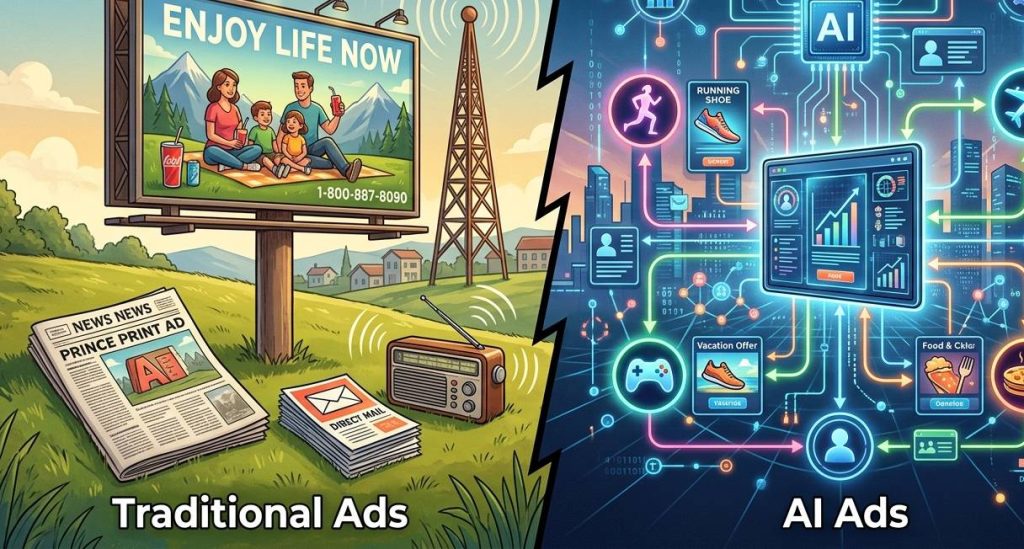
4. Flexibility: One Idea Doesn’t Have to Mean One Advertisement
This may be one of AI advertising’s biggest advantages.
A traditional commercial is normally planned around a defined production brief. Once filming has finished, there are practical limits to how dramatically the campaign can change without additional production.
AI makes the creative process more fluid.
A brand could potentially develop one core concept into different opening hooks, environments, formats or campaign variations.
A real estate company might create separate versions for investors and end users.
A restaurant could build different ads around individual menu items.
A fashion brand could develop multiple visual treatments around a new collection.
A logistics company could turn one campaign into separate stories around air freight, sea freight, warehousing and road transportation.
For instance:
- AI Ads for Real Estate
- AI Ads for Restaurants
- AI Ads for Clinics
- AI Ads for Tourism and Hospitality
- AI Ads for Fashion
- AI Ads for Logistics
- AI Ads for Financial Services
- AI Ads for Oil and Gas
Instead of thinking:
One campaign = one video
Brands can begin thinking:
One idea = multiple creative possibilities.
For businesses producing regular digital advertising, that flexibility can be extremely valuable.
The advantage: AI advertising.
Does This Mean Traditional Advertising Is Finished?
No.
There are campaigns where real people, real environments and physical production are essential to the idea.
Celebrity campaigns, emotionally driven human stories, major corporate films, interviews and certain luxury productions can benefit enormously from conventional filmmaking.
AI should not be forced into a campaign simply because it is available.
Likewise, brands should not automatically organise a large conventional production simply because that is how advertising has traditionally been made.
The medium should follow the idea.
When Does an AI Commercial Production Agency Make Sense?
Consider AI advertising production when you need:
- Faster campaign execution
- Regular social media advertising
- Multiple creative variations
- Product or concept visualisation
- Short-form commercials and Reels
- Creative concepts that are difficult to physically film
- Greater flexibility to experiment and refine ideas
Traditional production may be more appropriate when the campaign depends heavily on real personalities, authentic human interaction, specific physical environments or large-scale live production.
A brand could shoot its flagship campaign traditionally while using AI to develop supporting social advertisements and campaign variations.
Real footage can potentially work alongside AI-generated environments, visual effects and creative sequences.
The dividing line between AI advertising and traditional advertising may therefore become increasingly difficult to see.
And perhaps that is exactly where advertising is heading.
The question will no longer be:
“Was this made with AI?”
It will simply be:
“Is this a good ad?”
Contact Digiant Media, a top AI advertising and video production agency in Dubai, creating high-impact AI commercials and digital campaigns for brands across the UAE. Faster ideas. Smarter production. Greater creative possibilities.
